
The thesis: A large part of every company exists because moving information from A to B used to be expensive. That is exactly the work AI and agents are now taking over. Companies that only introduce the technology without rebuilding their structure will barely notice. Except through new competitors.
Why do companies exist at all?
Economics teaches us that markets are efficient. Prices reflect all available knowledge, and resources are used optimally. If that were true, there should be no companies. We would all be sole traders, buying every service on the market: the accountant for an hour, the developer for a feature, the salesperson per deal.
In reality we see corporations with tens of thousands of employees, layer upon layer of management. Something about the textbook model must be wrong.
In 1937, Ronald Coase asked exactly this question in “The Nature of the Firm”: why isn’t all economic activity organised through individual contracts on markets? His answer: markets are not free. Whoever buys a service externally has to find suppliers, judge quality, negotiate prices, draft contracts, monitor results and, if necessary, settle disputes in court. These transaction costs make using the market expensive. Companies therefore emerge wherever it is cheaper to employ people permanently and coordinate their work inside an organisation than to source every single service anew on the market.
Hierarchies are information machines
That is why companies built hierarchies. The principle goes back as far as the Roman Empire, which had to make a vast entity spread across regions and continents governable while information travelled slowly and expensively. What were then emperor, central administration, governors and local officials are today the executive board, headquarters, regional management and local sites. Reporting lines, delegated responsibility and binding rules were the answer to coordination over distance.
The reason is simple: with every additional person, the number of possible communication paths grows not linearly but quadratically. With ten people there are already 45 direct connections. Hierarchies bundle these connections. Instead of everyone talking to everyone, everyone talks to their own level.
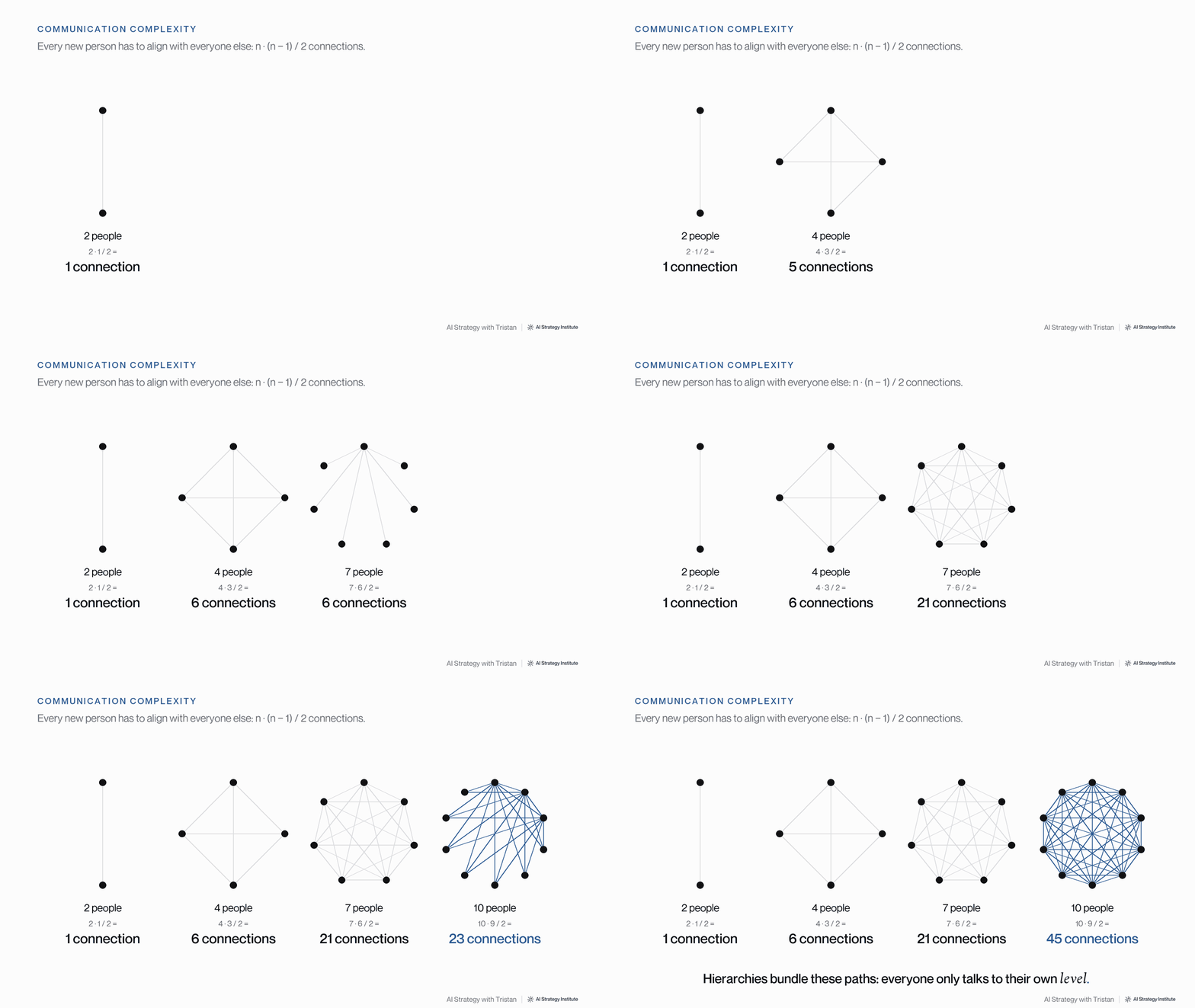
This structure exists to gather, consolidate and distribute information. And it is still found in our companies today, even though the internet, computers and the telephone have already cut transaction costs considerably. Middle management collects what happens below, translates it for the top and carries decisions back down. It coordinates people, checks quality, allocates budgets. Over the years, many companies have built up a thick layer of middle management this way.
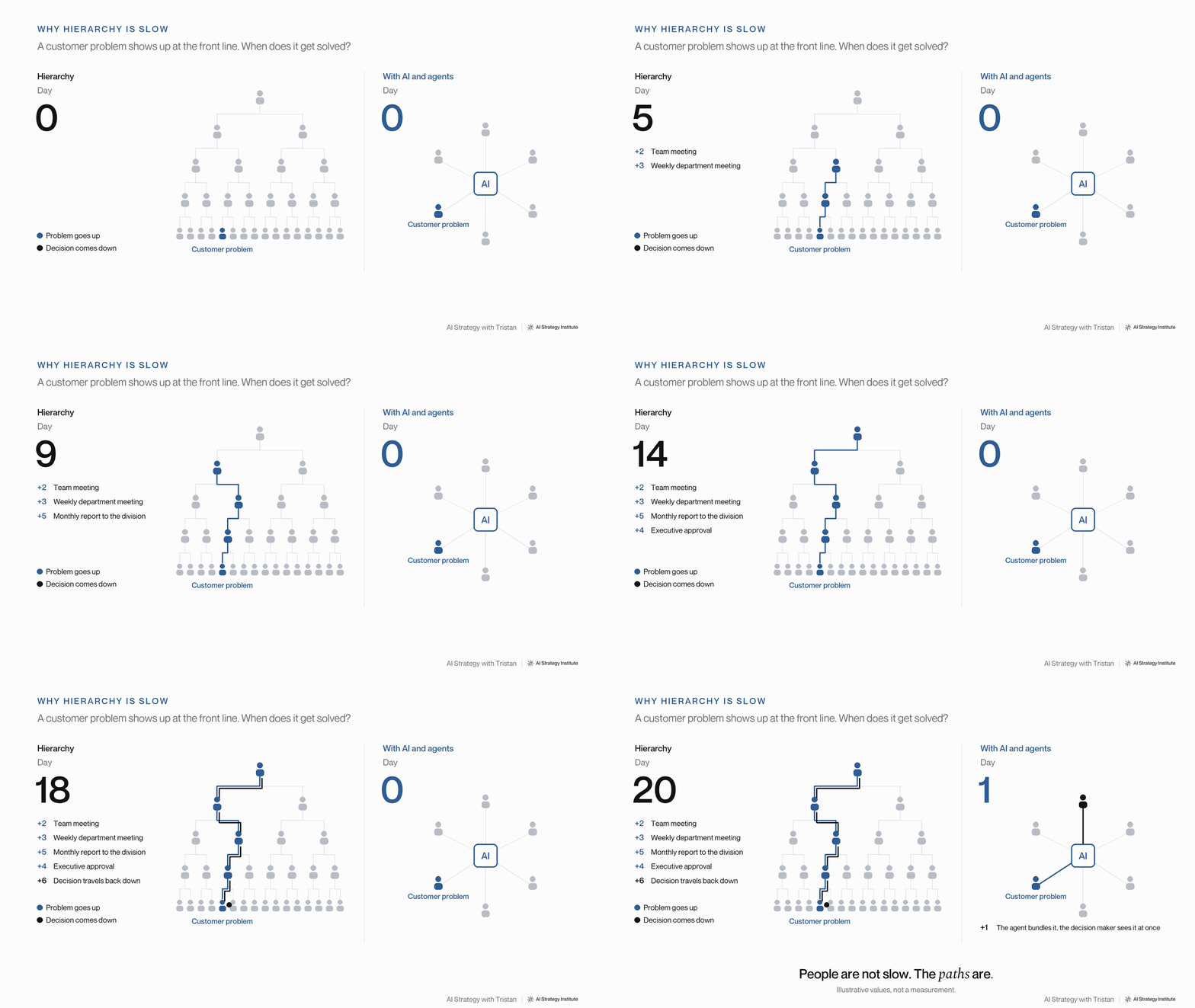
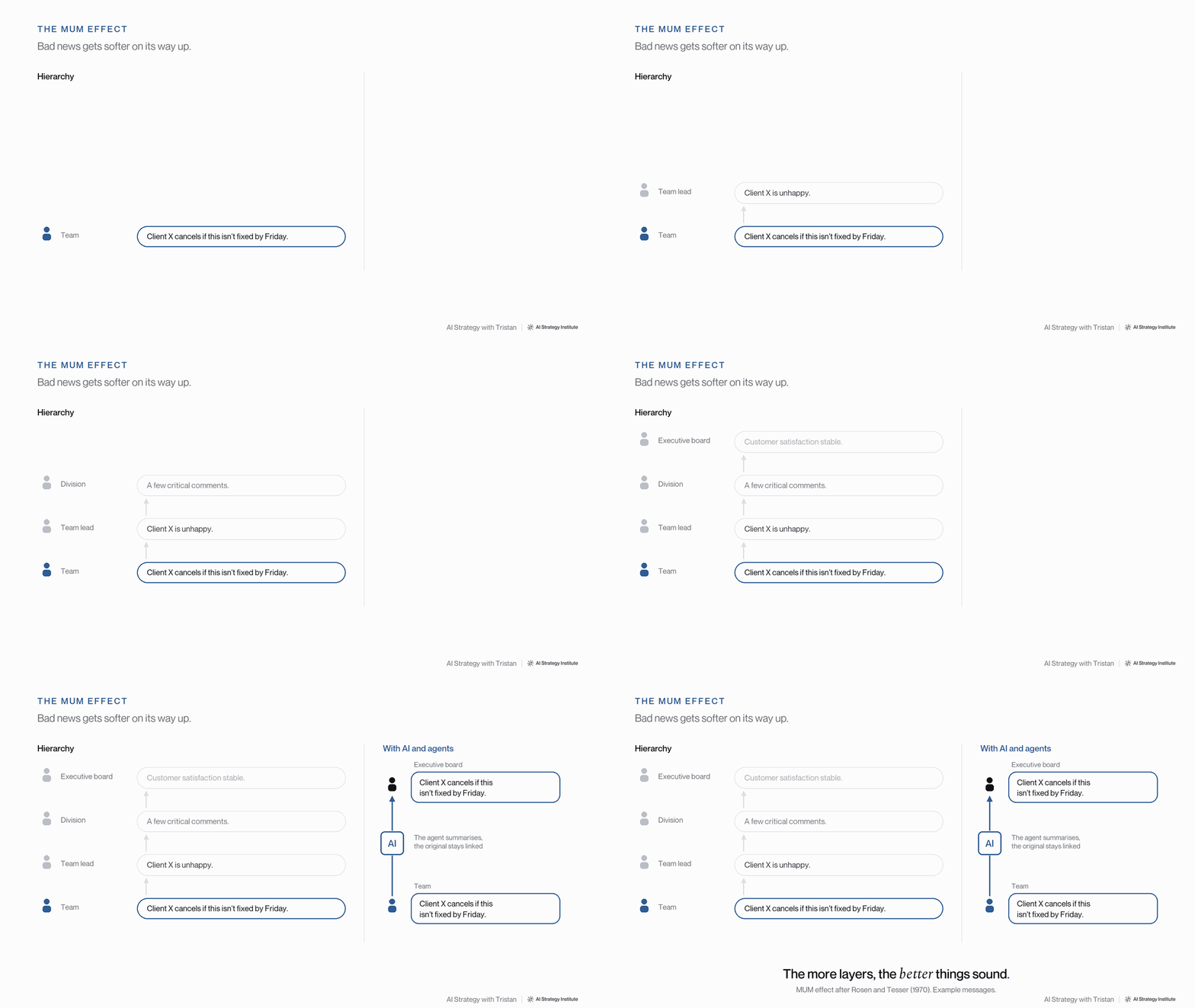
As long as passing on information was expensive, these structures made sense. But they come with the drawbacks of every bureaucracy: information is filtered and polished on its way up, decisions take time, and headquarters often cannot judge the situation on the ground. Psychologists call this the MUM effect: nobody likes passing bad news upwards, so it gets a little softer at every level. A governor far from Rome knew more about his province than the court, just as a sales team today knows more about customer problems than headquarters. These costs were accepted because there was no better alternative. And this is exactly where AI comes in.
From AI adoption to the AI-native firm
Right now we can watch in real time as AI moves into traditional companies. Pilots everywhere, licences being rolled out, people asking where AI could be used. Many companies are finding that the question is less what AI can do and more how to make the technology useful beyond individual productivity gains. Set up properly, it can make information in the company accessible to everyone.
When companies announce job cuts “because of AI” today, I don’t think that is the whole truth. AI did not replace those jobs. It revealed that many roles and processes consisted of coordination and passing on information. Anyone who has seen how much a single person can get done with AI, when it helps them find the right information at the right time, experiences a jump in productivity that calls the old structures into question. We see it in administration, where much of the work is processing information, and just as much in industries that live on information processing and information asymmetry: consulting, tax advice, law, where some clients now know how to help themselves thanks to AI. So we have to ask: which form of organisation coordinates a given activity at the lowest total cost and with the best results?
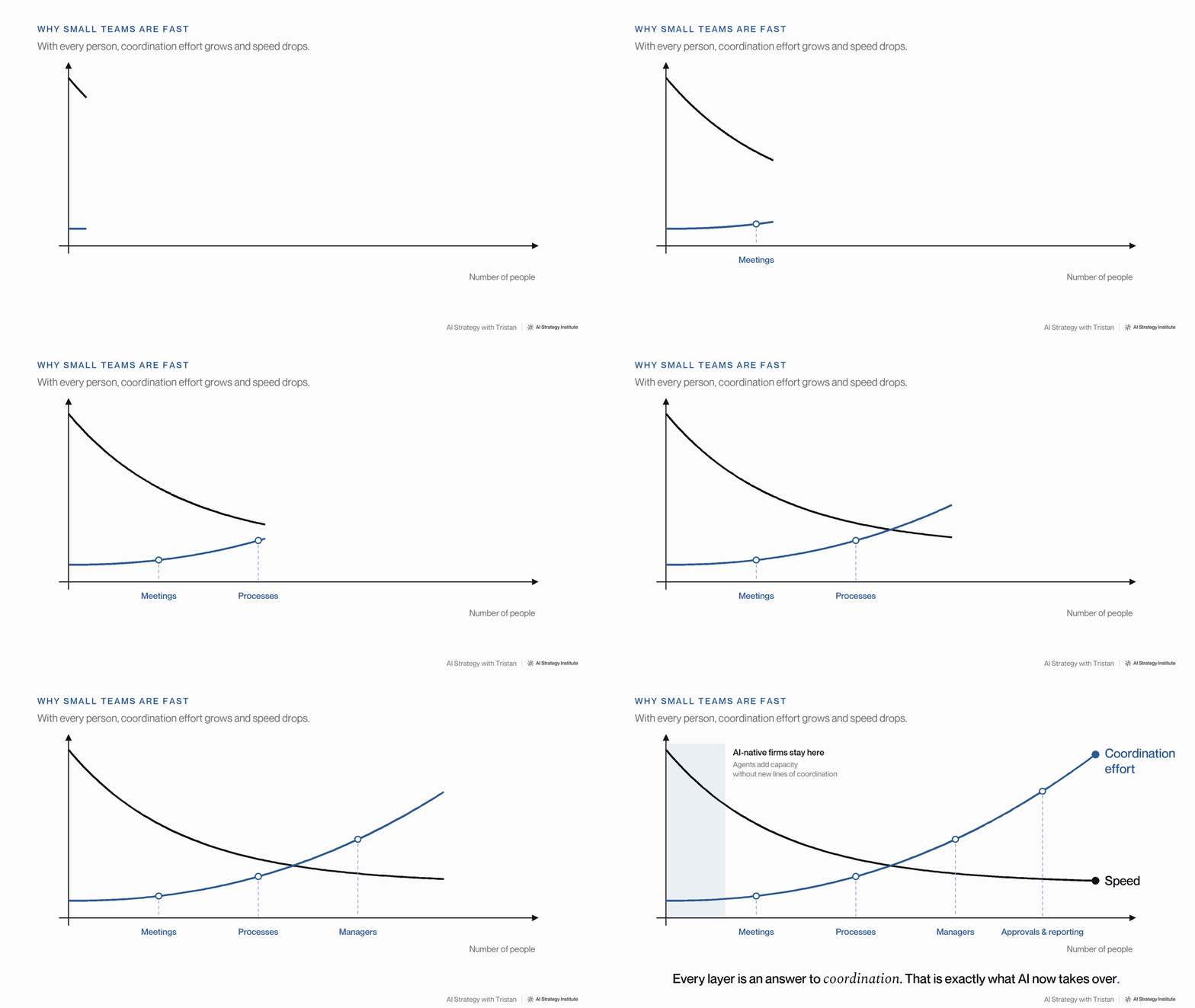
The new generation of firms springing up everywhere and turning old business models upside down shows us: AI-native companies, built around AI from day one instead of bolting it on later. Their teams are radically small. Functions that used to be whole departments sit with a single person and agents, whether marketing, finance or legal. Sam Altman put the pointed version into words: the one-person billion-dollar company, a billion-dollar firm with exactly one human. Whether it gets that far remains to be seen. The direction is already right: in April 2026 the New York Times profiled Medvi from Los Angeles, a company that made over 400 million dollars in revenue in 2025, with the founder and his brother as its only employee. This is possible because agents extend a team’s capacity without creating new communication paths between people. These firms deliberately stay below the threshold at which coordination needs its own structures and layers.
What AI really changes
AI can do exactly what the information machine called a company was built for: find, check, translate and move information from A to B, only without waiting time and without friction. Finding a specialist, specifying a task, checking quality, drafting a contract: what used to take weeks and the expertise of several departments, AI systems do in minutes. Agents go one step further. They don’t just push information around, they coordinate themselves while doing it: they break down a task, distribute the parts, check the results and put them back together. The more capable generative AI becomes, the more it moves beyond pure assistance and takes over the work of middle management.
The obvious objection is that the internet, email and ERP systems already did all this. The difference is crucial. Those technologies only moved information faster. The work in between, understanding, checking, deciding, coordinating, stayed with people. That is why computers and the internet did not abolish hierarchies but simply gave them faster lines. AI is the first technology that does this work itself. That is the qualitative leap.
Law shows how fast this tips. What used to require a large firm, searching case law, preparing briefs, reviewing thousands of pages, specialised AI systems now deliver. A single lawyer can call on the analytical capacity that once required a whole team of associates. The value never lay in the information itself but in the fact that obtaining it was expensive. This logic hits every industry whose core is information processing.
For the first time, this changes what Coase observed back then: the boundary of the firm lies where internal coordination costs as much as the market. AI lowers the cost on the market side. Expertise can now be found, vetted and brought in without hiring it permanently. Hollywood shows where this leads: for every film, a team of specialists is put together, directing, camera, editing, and disbands after the shoot. Nobody keeps a thousand people on the payroll just to make a film at some point. AI makes exactly this model feasible for more and more industries: projects instead of departments, expertise on demand instead of permanent employment.
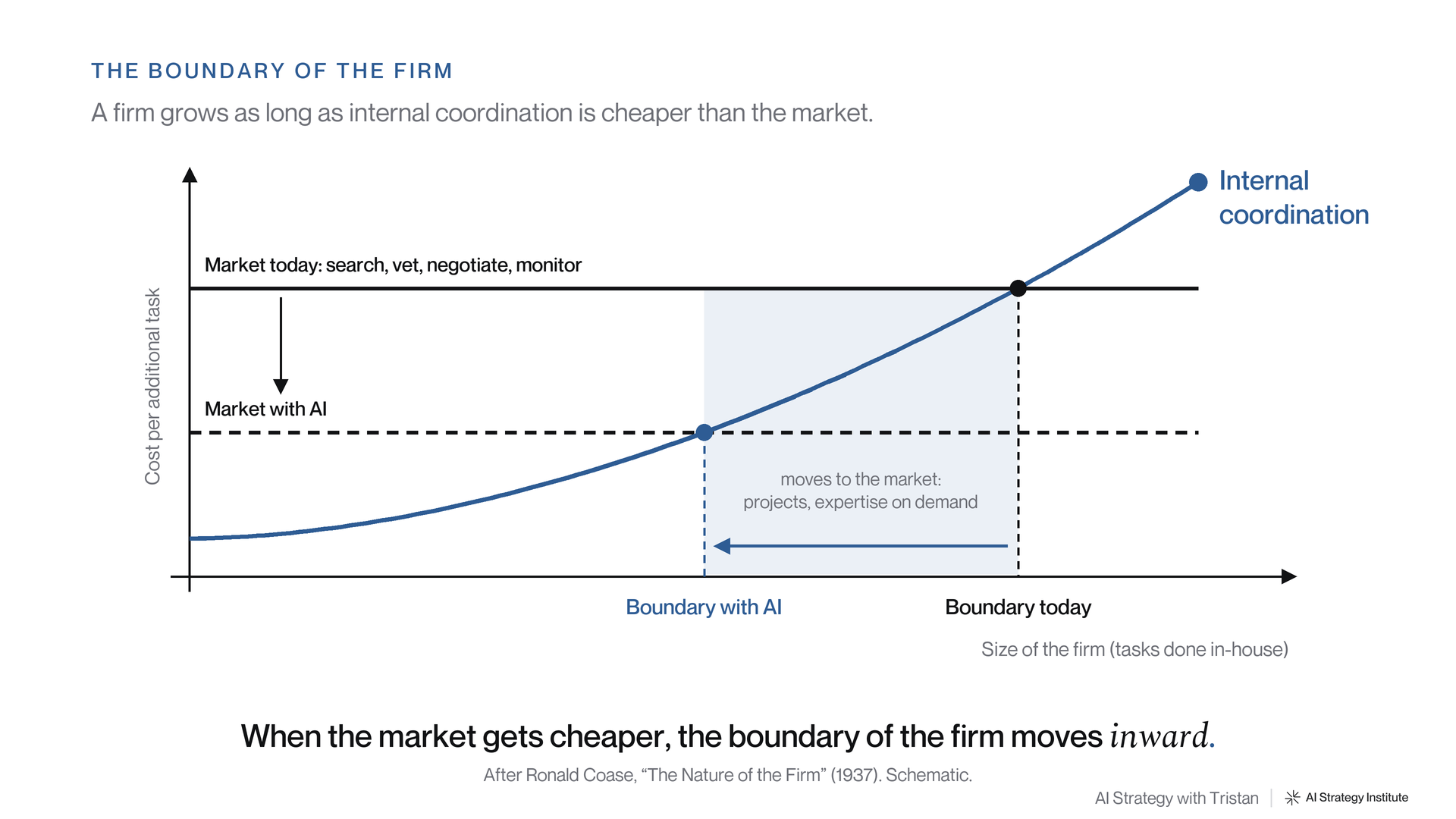
But that is only half the calculation. AI also lowers internal costs. Information flows faster through the organisation, and the translation work between layers disappears. That doesn’t happen by itself, though, only when the structure is actually rebuilt. Companies that introduce AI and leave the organisation unchanged get individual productivity: some employees get faster, but almost none of it shows up in the bottom line. The layers, the approvals, the alignment loops all remain. And with them remains what really makes organisations expensive and what no AI dissolves: status battles, silo thinking, inertia.
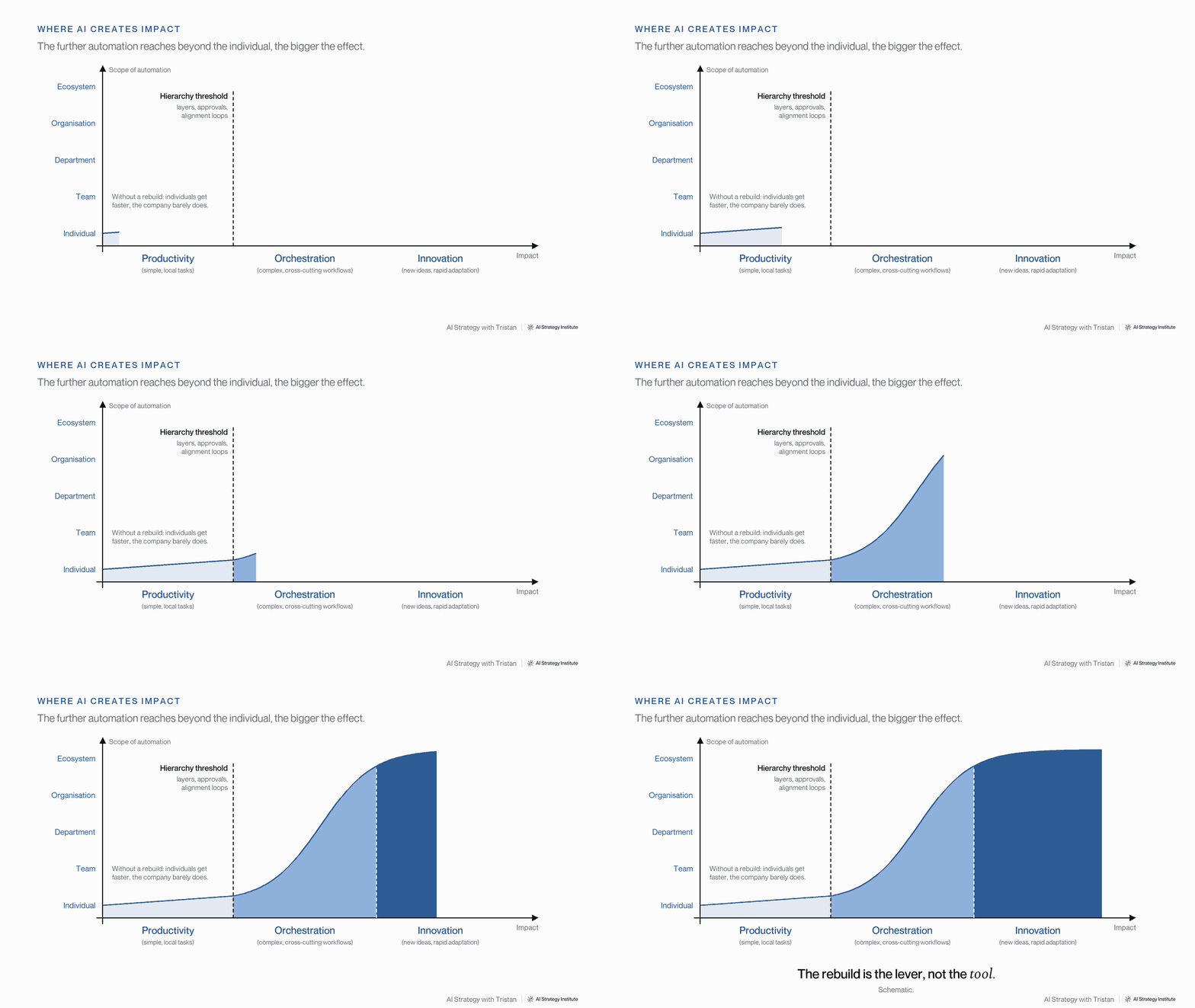
AI-native firms don’t have this problem. Their AI isn’t better. With a team of twenty, there simply are no layers to fight over. That gives them a double advantage, in cost and in speed. And that is the real threat to established companies. It isn’t AI itself, everyone has that, it now comes out of the socket like electricity. It is this new kind of company whose organisational structure doesn’t slow AI down.
By the way: the pattern is clearest where structures have been able to grow the longest, in the public sector. Large parts of public administration are pure information relay machines: checking applications, forwarding cases, clarifying responsibilities. The difference: they lack the competitor that forces them to rebuild. Companies don’t have that luxury.
So what does this mean in practice?
Three takeaways, and a first step you can take right away.
AI adoption is an organisational question, not a technology question. The question isn’t “Where can we use AI?” but “What does our structure need to look like when information flows freely?” Handing out licences only digitises your inertia.
Individual productivity is not the same as company results. As long as layers, approvals and alignment loops stay unchanged, the productivity gain seeps away into the structure. The rebuild is the lever, not the tool.
The benchmark is not yesterday’s competitor. The relevant comparison is the AI-native firm that doesn’t exist yet and that, in two years, will be in your market with twenty people.
The first step is to take a close look at your own information flow. Where does information originate, who prepares it, how many stations does it pass through before a decision is made? And which roles consist essentially of exactly that? Once you map this properly, you quickly see where your organisation still lives in a world where information was expensive. Incidentally, AI itself is excellent at helping with this analysis: documenting processes, clustering roles, making duplicate work visible.
Food for thought
Which department only exists because information used to be expensive?
Next Sunday: if the market becomes this cheap, what is left of the firm? The residual firm.